
AI Should Be Managed as a Digital Resource
A traditional tool executes a direct instruction. An AI system may access business data, generate code, recommend decisions, communicate with customers, trigger workflows, search internal knowledge, interact with APIs, and influence production systems.
Because AI can operate across multiple layers of the business, it requires the same management discipline applied to any valuable organisational resource: defined responsibilities, limited access, human supervision, performance measurement, and accountability.
AI should accelerate professional judgment, not replace it.
That principle should guide how teams design workflows, assign ownership, and decide where human approval remains mandatory.
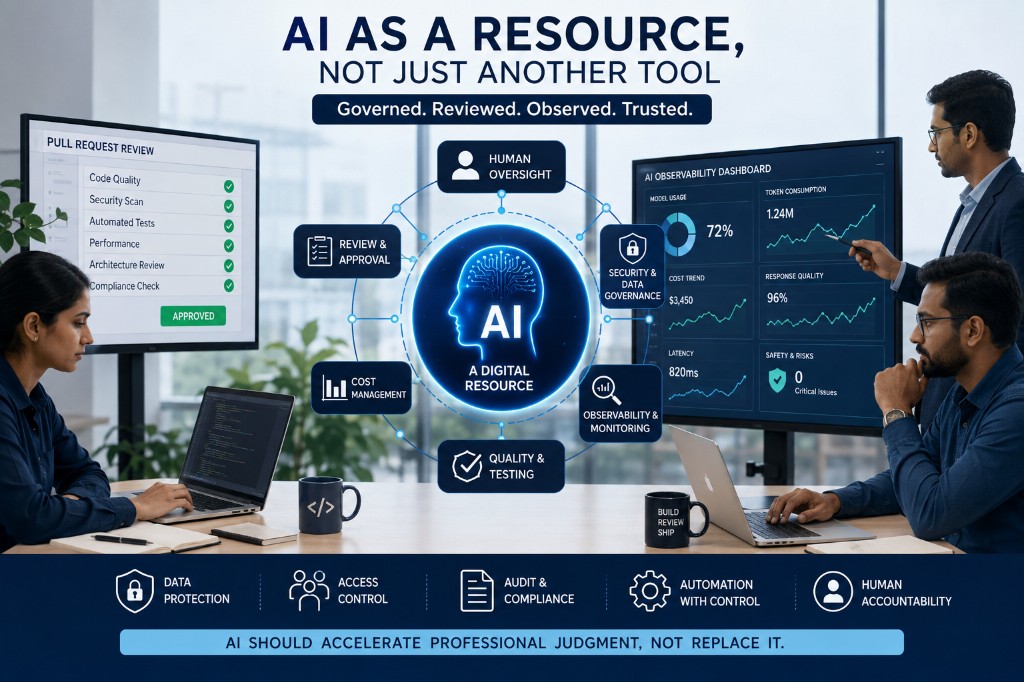
- Defined responsibilities for what AI is allowed to do
- Limited and controlled access to systems and data
- Human supervision for high-impact outputs and actions
- Review and approval processes before production changes
- Performance monitoring tied to business outcomes
- Security boundaries and cost accountability
- Auditability and production observability
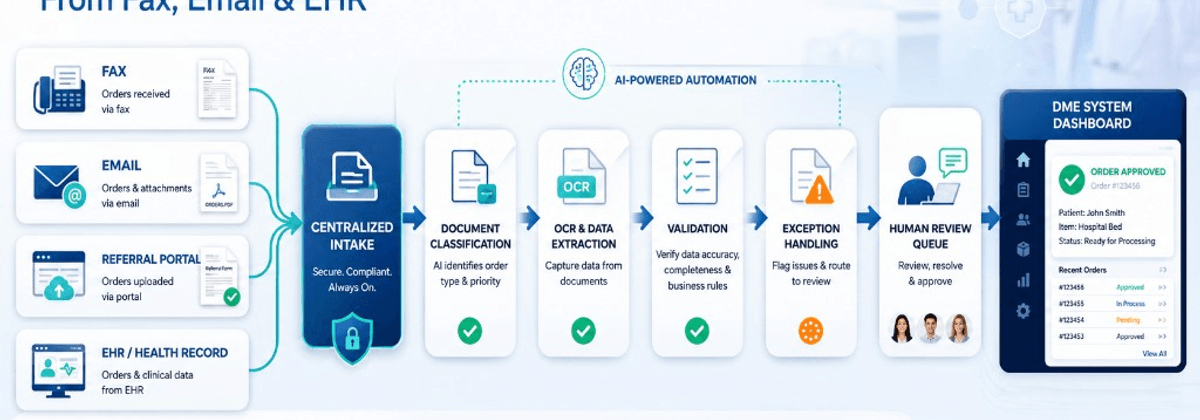
Human Review Must Remain Part of the Workflow
AI-generated output should not automatically become a production decision. Whether the output is code, a customer response, a workflow action, or a business recommendation, human review remains essential for enterprise reliability.
Human oversight is not a limitation of AI adoption. It is what allows organisations to scale AI safely while preserving accountability.
- Pull-request and peer reviews
- Architecture validation
- Unit and integration testing
- Security scanning
- Compliance checks
- Business approval for high-impact actions
- Controlled deployment pipelines
- Rollback and recovery procedures
AI-Generated Code Still Requires Engineering Governance
AI coding assistants can increase delivery speed, but they can also introduce security vulnerabilities, incorrect assumptions, unnecessary dependencies, duplicated logic, performance issues, inconsistent architecture, poor error handling, and hidden technical debt.
Generating code faster without disciplined review can create technical debt faster. AI-generated code should pass through the same engineering standards as human-written code.
- Code review by experienced engineers
- Static analysis and linting
- Dependency scanning
- Automated testing at unit and integration levels
- Performance validation under realistic load
- Security review for sensitive paths and data handling
- CI/CD quality gates before merge and release
- Production monitoring after deployment
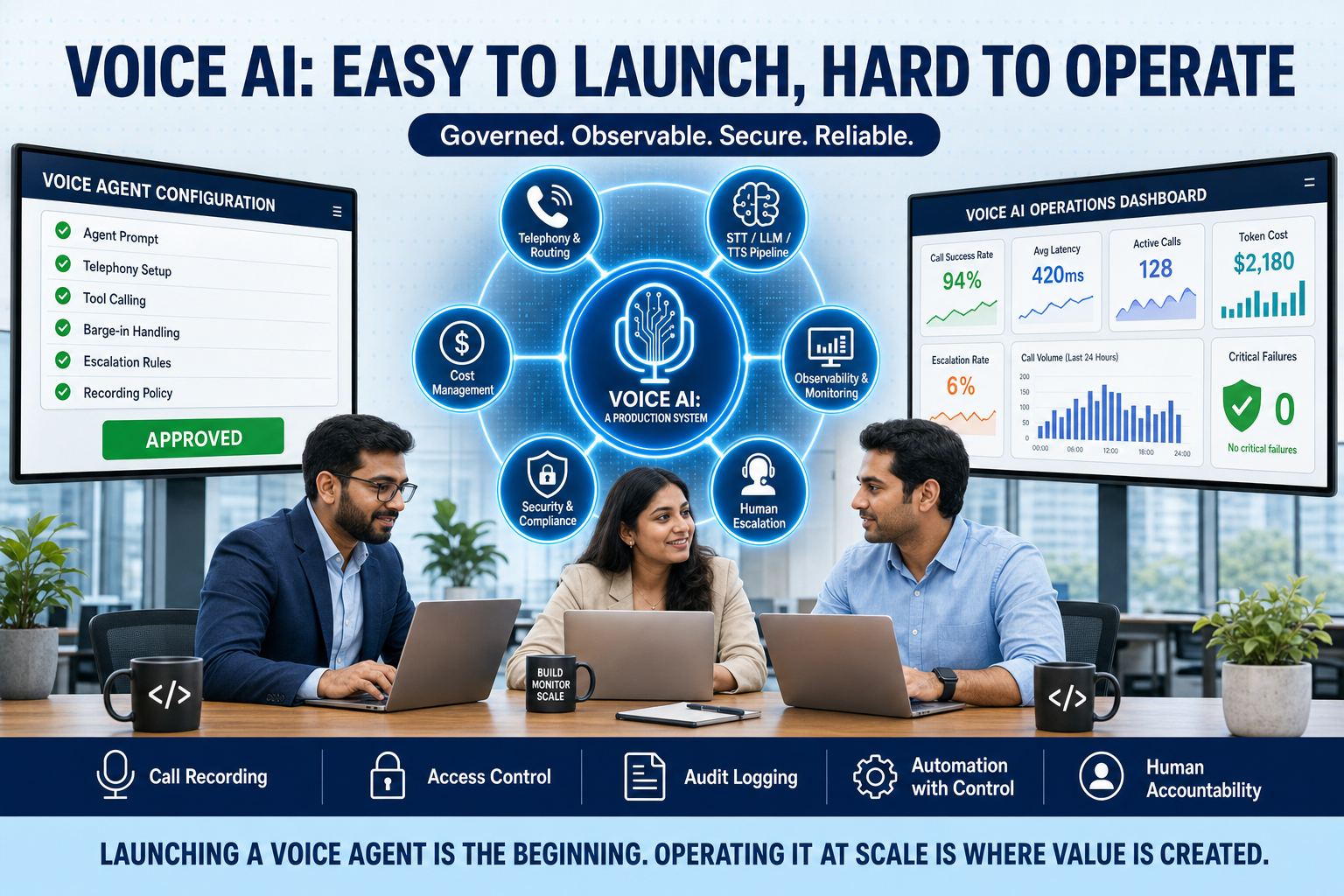
Production AI Requires End-to-End Observability
Traditional monitoring covers uptime, infrastructure health, latency, and application errors. Production AI systems require additional visibility because behaviour can vary by prompt, context, model, and tool execution.
Teams should be able to answer: What did the AI do? Why did it take that action? What data did it use? How much did the action cost? Was the output reviewed? How can the organisation intervene?
- Model and provider usage tracking
- Token consumption and cost monitoring
- Prompt and response traces
- Agent tool executions and decision paths
- Data shared with external models
- Response quality and hallucination rates
- Latency and failure rates
- Human overrides and escalation events
- Security events and policy violations
- Business outcome metrics tied to AI workflows
Data Governance Must Come Before AI Automation
Organisations should not expose customer, financial, healthcare, employee, intellectual-property, or confidential business data to AI systems without appropriate safeguards. Innovation without data governance can create regulatory, contractual, operational, and reputational risk.
- Data classification before AI integration
- Personally identifiable information masking
- Role-based access control
- Least-privilege access to systems and knowledge bases
- Approved model and vendor policies
- Secure prompt and response logging
- Data-retention controls
- Environment separation between development and production
- Prompt-injection protection
- Audit trails for AI-related data access
Measure Business Outcomes, Not Token Volume
Successful AI adoption should not be measured by the number of AI tools purchased, agents deployed, tokens consumed, prompts executed, or volume of generated content. Activity metrics can rise while business value stagnates.
Leadership teams should evaluate AI investments against operational and business impact—not usage volume alone.
- Reduced operational effort in targeted workflows
- Faster delivery with maintained quality standards
- Improved decision quality with traceable inputs
- Lower error rates in customer-facing and internal processes
- Better customer experience through reliable assistance
- Controlled AI expenditure aligned to budget accountability
- Increased employee productivity without unchecked dependency
- Reduced production risk through review and rollback readiness
- Improved security and compliance posture
How KyszTech Leverages AI
KyszTech treats AI as an integrated, governed resource within engineering and operational workflows—not as an unsupervised layer added on top of production systems.
We use AI to support software development, architecture analysis, code generation, test-case creation, documentation, knowledge retrieval, workflow automation, AI voice agents, customer-support workflows, and internal operational processes.
However, AI output remains subject to human review, pull-request approval, architecture standards, security validation, testing, CI/CD controls, production observability, and cost monitoring.
This operating philosophy informs how we deliver AI development, enterprise software development, and voice AI agents—including production work such as our Multilingual AI Voice Agent Platform case study.
Final Thoughts
The organisations receiving the highest long-term return from AI will not necessarily be the ones that adopt the most tools or consume the most tokens. They will be the ones that combine AI with human accountability, engineering discipline, governance, security, observability, cost control, and responsible deployment.
AI should work as part of the organisation—not operate outside its controls.
If your leadership team is evaluating how to move from AI experimentation to governed production systems, talk to KyszTech about a practical path forward.