


Context
The challenge
Organizations running surveys, customer engagement campaigns, appointment reminders, feedback collection, lead qualification, and support interactions often serve audiences that communicate in multiple languages. Traditional voice automation requires callers to select a language before the conversation begins—introducing friction, increasing abandonment, and feeling less natural. Most systems also assume callers stay in one language for the entire call. In reality, users frequently switch languages: beginning in English, moving to Hindi, Gujarati, Tamil, Bengali, or another preferred language to explain details, then returning to English later. Most voice agents cannot adapt to these runtime changes, resulting in misunderstandings, incorrect-language responses, and reduced engagement. Organizations need an intelligent platform that detects languages automatically, adapts responses dynamically, supports mid-conversation switching, and maintains natural dialogue without manual selection or language-specific routing.
How we worked
Our approach
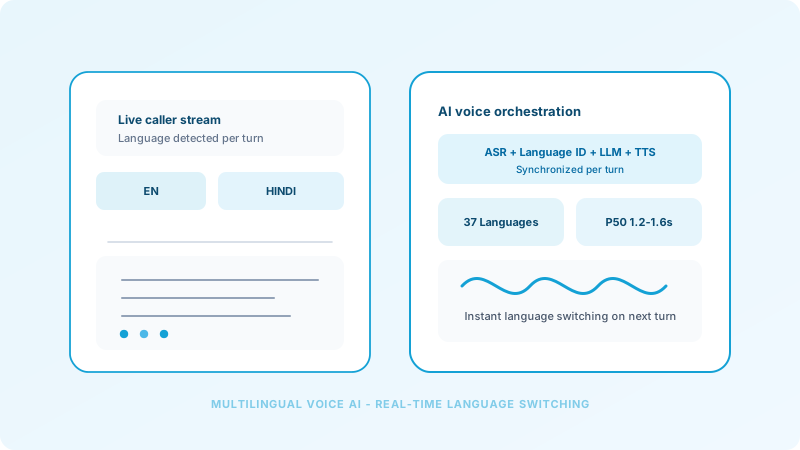
We architected a provider-agnostic, language-aware voice stack that identifies the caller’s language on every conversational turn and synchronizes speech recognition, language detection, LLM reasoning, and neural speech synthesis in a low-latency streaming pipeline. The design supports mixed-language and code-switching interactions while preserving context, captures per-turn language metadata for analytics and compliance, and applies confidence-based fallback when detection is uncertain. Speech recognition, language identification, and TTS providers can be selected, replaced, or upgraded based on language coverage, transcription quality, voice preferences, latency, and budget—without rebuilding core conversation flows. Regional Indian languages sit alongside international languages within a single platform, enabling one voice agent to serve diverse audiences without separate bots or language-specific call paths.
Delivery
The solution
The Multilingual AI Voice Agent Platform delivers real-time language-aware interactions powered by streaming speech recognition, dynamic language identification, conversational AI, and multilingual neural voice synthesis. On each turn, the system detects the caller’s language and generates responses in that language while TTS adapts to the matching locale. When a caller switches mid-call—for example from English to Hindi (“Mujhe Hindi mein samjhaiye”), then to Gujarati (“હવે ગુજરાતી માં કહો”), then back to English—the agent transitions on the next turn without menus, transfers, or restarts. Capabilities include real-time language identification, dynamic language-aware prompting, mixed-language conversation support, voice activity detection for responsive turn-taking, outbound campaign integration for surveys and lead qualification, and operational monitoring with language distribution analytics and latency tracking. Cloud telephony with WebSocket audio streaming, containerized microservices, and observability underpin enterprise-scale inbound and outbound deployments.
Results
Key metrics
- Per-turn detection & response
- Language Adaptation
- Mid-call, no restart
- Runtime Switching
- Global + regional Indian languages
- Coverage
- Provider-agnostic ASR / TTS
- Architecture
Impact
Results & outcomes
- Automatic language detection eliminates menus and keypad language selection
- Runtime language switching lets callers change languages naturally without user action
- International and regional Indian languages supported from a single unified platform
- Higher engagement and survey completion through frictionless, human-like conversations
- Accurate language-level analytics, compliance monitoring, and multilingual performance tracking
- Cost-efficient operations without maintaining separate voice bots per language
- Future-proof, provider-agnostic architecture for evolving ASR, LID, and TTS requirements
- Expanded audience reach and improved accessibility across diverse language communities
Tech used
Technology stack
Tools and patterns from this engagement—your stack may differ.