


RAG & Knowledge Base Systems
Build Retrieval-Augmented Generation systems that enable AI to search your knowledge base and provide accurate, context-aware answers from company data.
Turn your documents and knowledge into intelligent AI assistants.
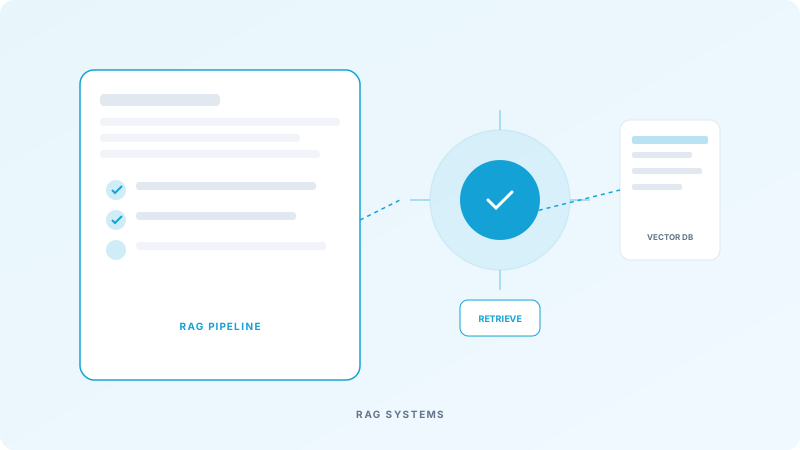
Generic LLMs hallucinate on proprietary data. RAG grounds answers in your documents, wikis, policies, and product manuals—with citations users can verify. We build ingestion pipelines, embedding strategies, and retrieval layers tuned to your content volume, update frequency, and accuracy requirements. Retrieval quality is continuously evaluated against real user queries—not just benchmark scores. We also handle access control so teams only see knowledge they are permitted to access.
How We Deliver Value
Hybrid retrieval combining semantic search, keyword matching, and metadata filters
Source citations on every answer so teams can trust and audit responses
Pipelines that keep knowledge fresh as documents, tickets, and policies change
Key Features
- Document ingestion (PDF, DOCX, HTML)
- Vector embeddings and semantic search
- Hybrid search (keyword + vector)
- Source citations and traceability
- Multi-tenant knowledge systems
- Real-time document updates
- Chunking strategies optimized per document type
- Access control and role-based knowledge scopes
Use Cases
- Internal enterprise knowledge assistants
- Customer support AI chatbots
- Legal document search
- Technical documentation assistants
- Research assistants
- Sales enablement and proposal drafting
- Policy and compliance Q&A for employees
Frequently Asked Questions
Everything you need to know about RAG & Knowledge Base Systems
PDFs, Word docs, HTML pages, Confluence/Notion exports, help-center articles, tickets, and structured databases. We design parsers and chunking rules per source type for best retrieval quality.
We use grounded generation with strict context windows, citation requirements, confidence scoring, and fallback responses when retrieved context is insufficient.