
Your LLM Is Only as Good as the Context You Give It
If retrieval returns irrelevant or incomplete information, even the most advanced reasoning model will struggle to produce accurate answers.
Vector similarity alone often surfaces near-matches that look related in embedding space but miss the facts, constraints, or source documents the user actually needs. When that happens, teams blame the model—when the real failure started one step earlier.
Strong generation cannot compensate for weak retrieval. Grounded answers require the right passages, with the right metadata, in the right order.
The Demo Recipe Is Not a Production Architecture
Chunk → embed → similarity search → prompt is a useful starting point. It is not a complete retrieval system.
Production RAG has to survive messy corpora, overlapping topics, ambiguous queries, multi-document answers, policy constraints, and the expectation that answers can be audited. That means treating retrieval as an engineered pipeline—not a single vector call.
- Naive fixed-size chunking that splits meaning across boundaries
- Embedding-only search that misses exact terms, IDs, and policy language
- No re-ranking, so top-k noise reaches the model
- No metadata filters for tenant, date, product, or document type
- No evaluation loop to measure retrieval quality over time
- Answers without reliable citations or source traceability
What a Production-Ready RAG System Requires
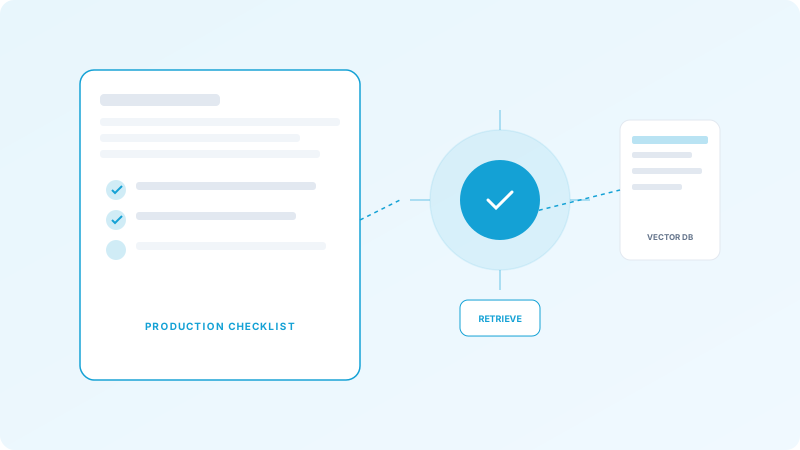
A production-ready RAG system is much more than vector search. It requires deliberate design across chunking, retrieval, ranking, filtering, evaluation, and citation.
These capabilities compound. Hybrid retrieval finds better candidates. Re-ranking prioritises them. Metadata filtering keeps answers in scope. Evaluation tells you whether the pipeline is improving. Citations make the system trustworthy for enterprise use.
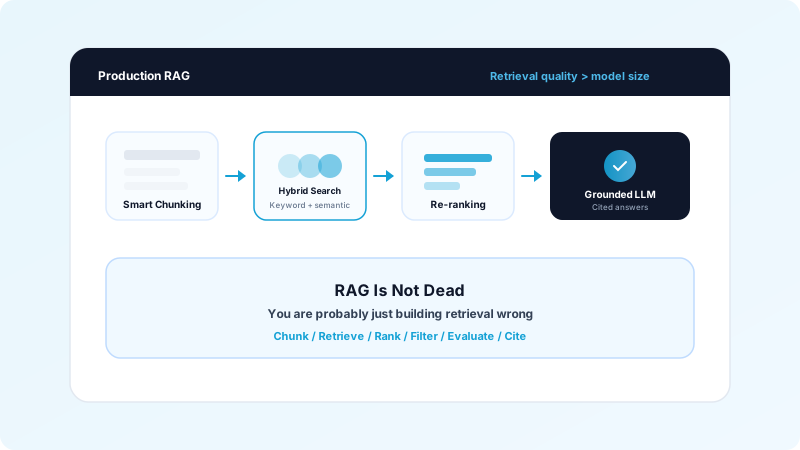
- Smart chunking that respects semantic boundaries and document structure
- Hybrid retrieval combining keyword and semantic search
- Re-ranking to promote the most relevant evidence before generation
- Metadata filtering for tenancy, recency, source type, and access control
- Evaluation of retrieval and answer quality—not just latency demos
- Reliable citations so users can verify where answers came from
Reasoning Models Do Not Replace Retrieval
Reasoning models are making AI more capable, but they do not replace retrieval. They still need the right information to reason over.
Better reasoning can help synthesise evidence and handle multi-step questions—but if the evidence never entered the context window, the model cannot invent trustworthy enterprise facts from thin air.
That is why retrieval quality remains a first-class engineering problem even as models get stronger.
RAG Isn't Dying—It's Evolving
RAG isn't dying—it's evolving.
The future of enterprise AI isn't about using a bigger model. It's about building a better retrieval pipeline.
Teams that invest in chunking strategy, hybrid search, re-ranking, metadata discipline, evaluation, and citation will get more accurate, auditable systems than teams that only chase the next model release.
If you are designing or hardening RAG for production, explore how we approach AI product development and RAG systems—or talk to KyszTech about your retrieval architecture.
Your Thoughts?
Do you think RAG is being replaced, or are we finally learning how to build it properly?
The teams seeing durable value from enterprise AI are usually the ones treating retrieval as a product capability—measured, iterated, and owned—not as a one-time vector index setup.