
Introduction: Interoperability Is Now a Strategic Priority
Healthcare has no shortage of data, but the real challenge is interoperability. Patient records are often scattered across EMR, EHR, billing, claims, pharmacy, lab, HME, and DME systems.
AWS is helping healthcare organizations move from disconnected systems to secure, interoperable, intelligent healthcare platforms that improve care coordination and operational performance.
Why this matters for healthcare leaders now
Interoperability is no longer only an IT initiative. It directly affects growth, patient satisfaction, reimbursement velocity, and operating margins for healthcare providers and digital health platforms.
Leaders across provider groups, healthcare SaaS, and HME/DME operations are prioritizing:
- Faster, more reliable patient data access
- Lower administrative overhead across teams
- Better care-team decision support in daily workflows
- Scalable foundations for analytics and AI agents
Why the Interoperability Problem Persists
Siloed EMR and EHR ecosystems
Many EMR and EHR systems still operate as separate environments, with limited real-time synchronization and inconsistent data structures.
As a result, teams often spend more time reconciling patient data than acting on it.
Complex HME and DME workflows
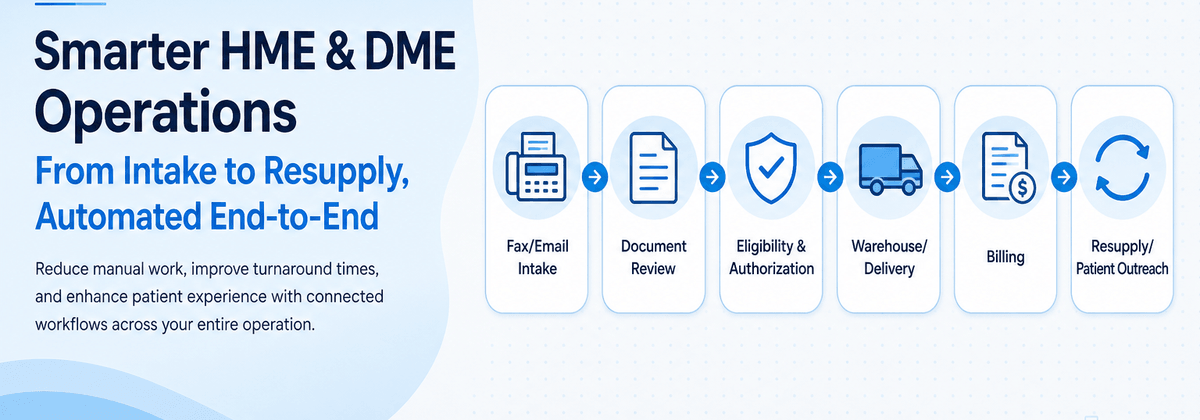
HME and DME providers depend on tightly connected processes, including:
When these steps rely on fax, email, and manual follow-up, delays and errors become operationally normal.
Operational and patient impact
Fragmented systems can cause:
Healthcare teams need secure healthcare data exchange that is standardized, API-driven, and designed for near real-time clinical workflows.
- Prescription intake
- Eligibility checks
- Prior authorizations
- Documentation validation
- Delivery updates
- Billing readiness
- Slower order-to-care timelines
- Duplicate data entry
- Incomplete documentation
- Lower staff productivity
- Poor patient communication experiences
FHIR as the Foundation for Modern Healthcare Interoperability
FHIR has become the modern standard for healthcare interoperability because it creates a consistent way to represent and exchange healthcare data through APIs.
What FHIR enables across systems
FHIR resources support structured exchange of:
With FHIR, integration becomes more scalable and maintainable across EMR, EHR, payer, and operational systems.
- Patient demographics
- Appointments and encounters
- Medications and observations
- Insurance and coverage details
- Clinical notes and care context
AWS HealthLake: Building a FHIR-Centered Data Foundation
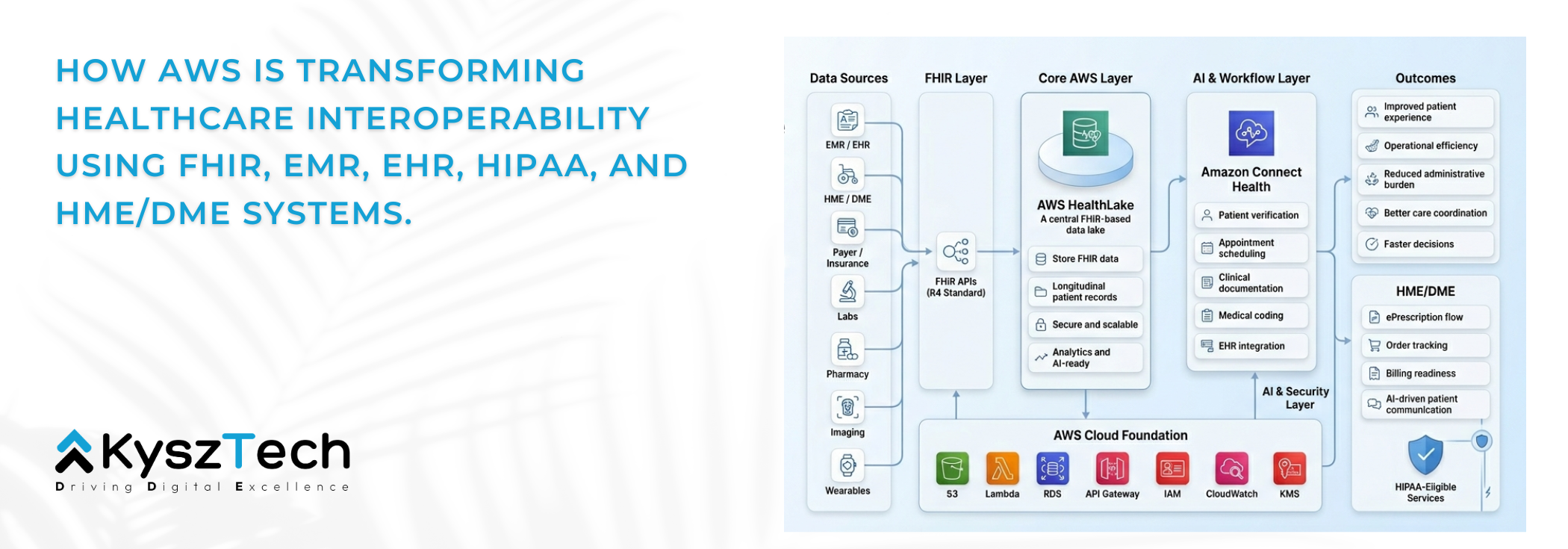
AWS HealthLake is a HIPAA-eligible, FHIR-based service for storing, analyzing, and sharing healthcare data in the cloud.
Why it matters for enterprise healthcare teams
AWS HealthLake provides:
It also creates a strong foundation for AI, analytics, and retrieval-augmented generation (RAG) applications that need high-quality healthcare context.
- A FHIR R4 data store model for standardized records
- Centralized longitudinal patient data across sources
- Secure cloud-native storage and access controls
- Query and analytics capabilities for operational and clinical insights
- A practical path to breaking long-standing data silos
Amazon Connect Health: AI-Powered Frontline Workflows
Amazon Connect Health is an AI-powered healthcare service built on Amazon Connect that helps modernize patient and care-team interactions.
High-value workflow opportunities
Organizations can use it to support:
The outcome is not only better patient access, but also reduced administrative workload and improved productivity for care teams.
- Patient scheduling workflows
- Patient verification processes
- Clinical documentation flows
- Medical coding support steps
- EHR integration through FHIR APIs
HME and DME Use Cases: Practical Interoperability Gains
For HME and DME businesses, AWS-based interoperability can directly improve operational execution.
Where business impact is most visible
Teams can connect prescription, patient, payer, authorization, documentation, and delivery workflows inside one coordinated architecture.
This enables:
For growing HME and DME organizations, these gains often translate into faster service delivery and lower back-office friction.
- Less manual fax/email coordination
- Faster and cleaner order intake
- Better documentation accuracy
- Automated follow-ups and status updates
- Stronger compliance and billing readiness
- Patient communication support through voice AI and workflow automation
HIPAA, Security, and Trust by Design
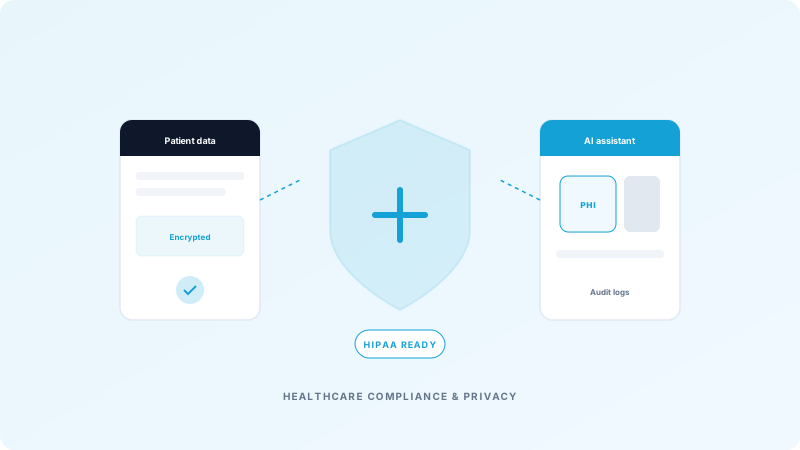
AWS provides HIPAA-eligible services, but compliance depends on how the platform is designed, implemented, and governed.
Security and governance controls to prioritize
Healthcare teams should build with:
The key message: cloud services enable secure architecture patterns, but accountability remains with the organization operating the system.
- IAM-based identity and least-privilege access
- Encryption at rest and in transit
- CloudTrail monitoring and audit logs
- Secure API design and authentication controls
- Data governance policies and lifecycle controls
- Business Associate Agreements (BAAs) where required
Beyond Storage: The Rise of AI-Powered Care Workflows
The future of healthcare interoperability is not only about storing patient data. It is about acting on that data across teams, channels, and systems.
What becomes possible with AWS-enabled platforms
Healthcare organizations can build:
These capabilities can improve both patient experience and operational resilience when implemented with strong governance.
- AI agents for patient engagement and navigation
- Automated summaries for clinical and operational context
- Clinical documentation support for care teams
- Intelligent routing across contact and service workflows
- RAG over healthcare records for faster information access
- Proactive care coordination workflows triggered by events
How KyszTech Can Help
KyszTech helps healthcare and enterprise teams design and build secure, scalable, AI-enabled healthcare platforms using cloud-native architecture.
Our capabilities include:
We focus on practical delivery, measurable outcomes, and systems that can scale with regulatory, operational, and product complexity.
- FHIR integrations and interoperability architecture
- EMR/EHR connectivity and workflow orchestration
- Automation for documentation and operational tasks
- Voice AI experiences for patient and team communication
- Agentic AI systems aligned to business and clinical workflows
Conclusion
Healthcare interoperability is moving from a technical integration problem to a business transformation opportunity.
With AWS HealthLake, Amazon Connect Health, FHIR, and secure cloud architecture, healthcare organizations can build systems that are connected, intelligent, compliant, and patient-centric.
Leaders who invest now in secure healthcare data exchange and AI-enabled workflows will be better positioned to improve care coordination, reduce operational inefficiency, and deliver stronger long-term digital health outcomes.