Retell AI and Vapi Solve Platform Problems
Platforms such as Retell AI and Vapi provide valuable infrastructure that accelerates development. They help teams move from proof-of-concept to deployment much faster than building every component from scratch.
Typical capabilities include call orchestration, agent configuration, telephony integration, prompt management, tool calling, analytics dashboards, voice selection, and call routing.
However, no platform removes the need for production governance. Voice AI success depends as much on operational design as platform capabilities.
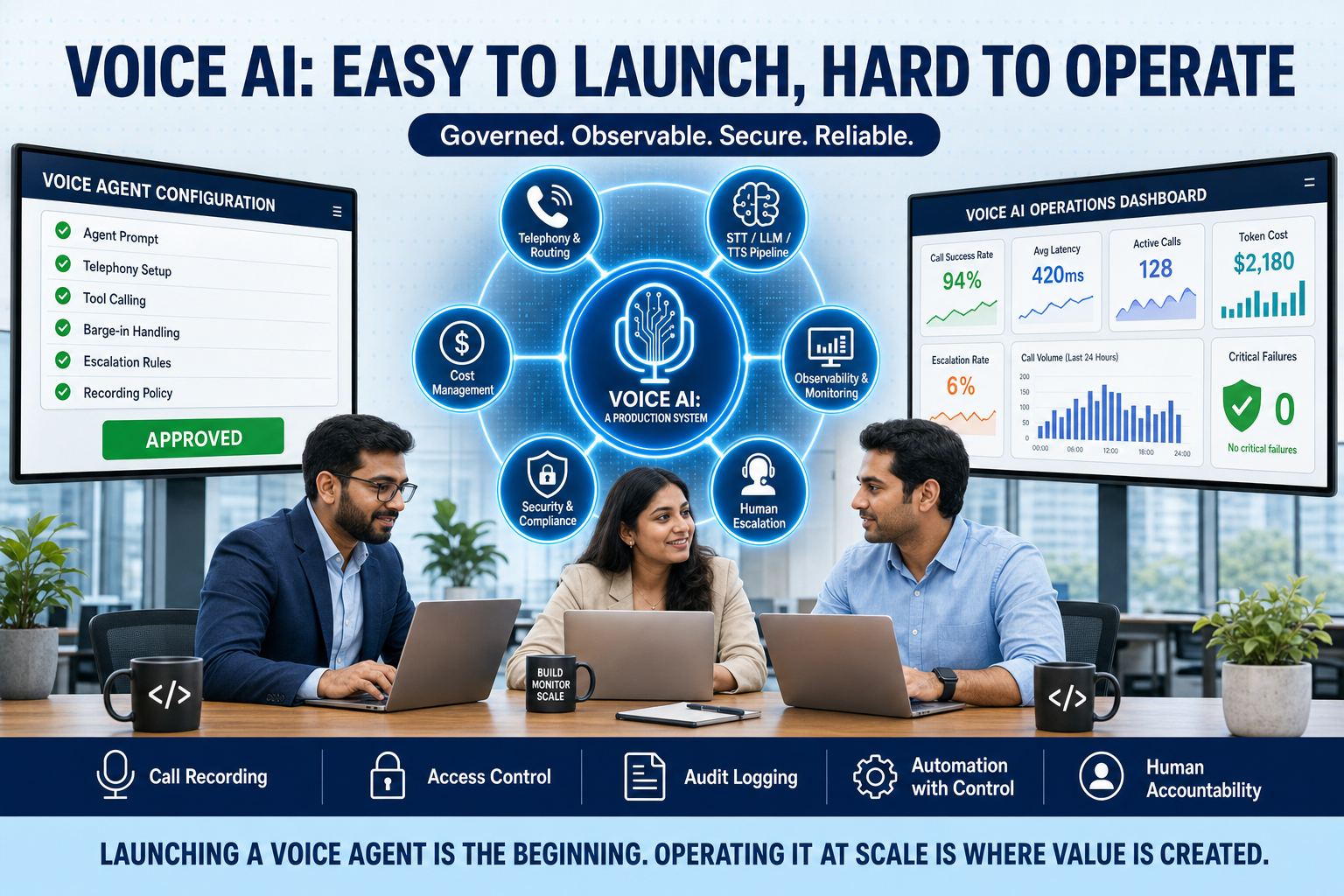
- What actions agents are allowed to perform
- When human escalation is required
- How sensitive data is protected
- Which systems can be accessed
- How failures are detected and recovered
- How costs are monitored
- How performance is measured
Custom Voice AI Becomes Important at Scale
Many organisations eventually require capabilities beyond standard platform configurations. In these scenarios, teams often combine commercial platforms with custom backend services and business logic.
The goal is not necessarily replacing Retell AI or Vapi. The goal is extending voice AI capabilities while maintaining operational control.
- Custom workflow orchestration
- Industry-specific compliance controls
- Proprietary knowledge retrieval
- Internal system integrations
- Advanced reporting requirements
- Multi-provider failover strategies
- Custom interruption handling
- Specialized security requirements
- Regional deployment constraints
Human Oversight Still Matters
Voice AI can answer questions, qualify leads, schedule appointments, collect information, and automate repetitive interactions. That does not mean every decision should be automated.
AI should accelerate customer service and operational efficiency while preserving accountability. The most successful deployments combine automation with clear escalation paths.
- High-value customer interactions
- Financial decisions
- Contract discussions
- Escalation scenarios
- Compliance-sensitive workflows
- Exception handling
Production Voice AI Requires Observability
A common mistake is treating voice AI like a black box. When issues occur, teams must be able to answer why a call failed, why an agent transferred the call, which API request caused delay, what information was provided to the model, which workflow step generated an error, and how much the interaction cost.
Without observability, voice AI becomes difficult to maintain as adoption grows.
- Call success and completion rates
- Response latency tracking
- Tool execution monitoring
- AI model usage analytics
- Token consumption and cost reporting
- Customer sentiment tracking
- Escalation metrics
- Error and failure reporting
- Conversation traceability
Security and Data Governance Cannot Be an Afterthought
Voice AI systems frequently process customer information, appointment details, internal business knowledge, financial information, support requests, and CRM records.
Before automation is expanded, organisations should establish controls that keep voice AI within existing security and compliance frameworks—not outside them.
- Role-based access controls
- Data masking policies
- Secure API authentication
- Vendor approval processes
- Call recording policies
- Audit logging
- Environment separation
- Prompt injection protection
Measure Business Outcomes, Not Call Volume
Many organisations evaluate success using activity metrics such as number of calls handled, minutes processed, tokens consumed, or agents deployed. These metrics do not necessarily reflect business value.
The objective is measurable business impact—not simply automation volume.
- Reduced support workload
- Faster response times
- Higher appointment conversion rates
- Improved customer satisfaction
- Reduced operational costs
- Lower wait times
- Increased lead qualification efficiency
- Improved service availability
How KyszTech Leverages Voice AI
KyszTech builds and integrates voice AI solutions using modern conversational AI technologies, telephony platforms, workflow automation systems, and custom backend services.
Whether leveraging platforms such as Retell AI and Vapi or developing custom voice AI architectures, our focus remains the same: reliable, observable, secure, and production-ready systems.
Our voice AI work spans multilingual agents, customer support automation, appointment scheduling, lead qualification, CRM integrations, and production monitoring—including implementations such as our Multilingual AI Voice Agent Platform. Explore our voice AI agents service to see how we help teams move from prototype to production.
- Multilingual voice agents
- Customer support automation
- Appointment scheduling
- Lead qualification
- Business workflow automation
- Knowledge retrieval systems
- CRM integrations
- Production monitoring
- Cost optimization
- Security and governance controls
Final Thoughts
The organisations achieving the greatest return from voice AI are not necessarily those deploying the largest number of agents. They are the organisations that treat voice AI as a production system requiring governance, observability, security, cost management, and human accountability.
Launching a voice AI agent is the beginning of the journey. Operating a reliable voice AI platform at scale is where long-term business value is created.
If your organisation is evaluating Retell AI, Vapi, or a custom voice AI solution, talk to KyszTech about designing a practical path from prototype to production.