


Context
The challenge
Healthcare organizations frequently receive patient referrals and order documents in various formats, including prescriptions, insurance cards, and clinical documentation. Traditionally, staff manually review these documents and enter information into order management systems, resulting in delayed order processing and patient onboarding, increased risk of human errors during data entry, operational bottlenecks caused by high document volumes, difficulty maintaining document traceability and audit readiness, and challenges synchronizing extracted data across multiple healthcare platforms. Organizations require an automated document processing solution capable of extracting, validating, enriching, and persisting healthcare order information while maintaining data quality, compliance, and operational efficiency.
How we worked
Our approach
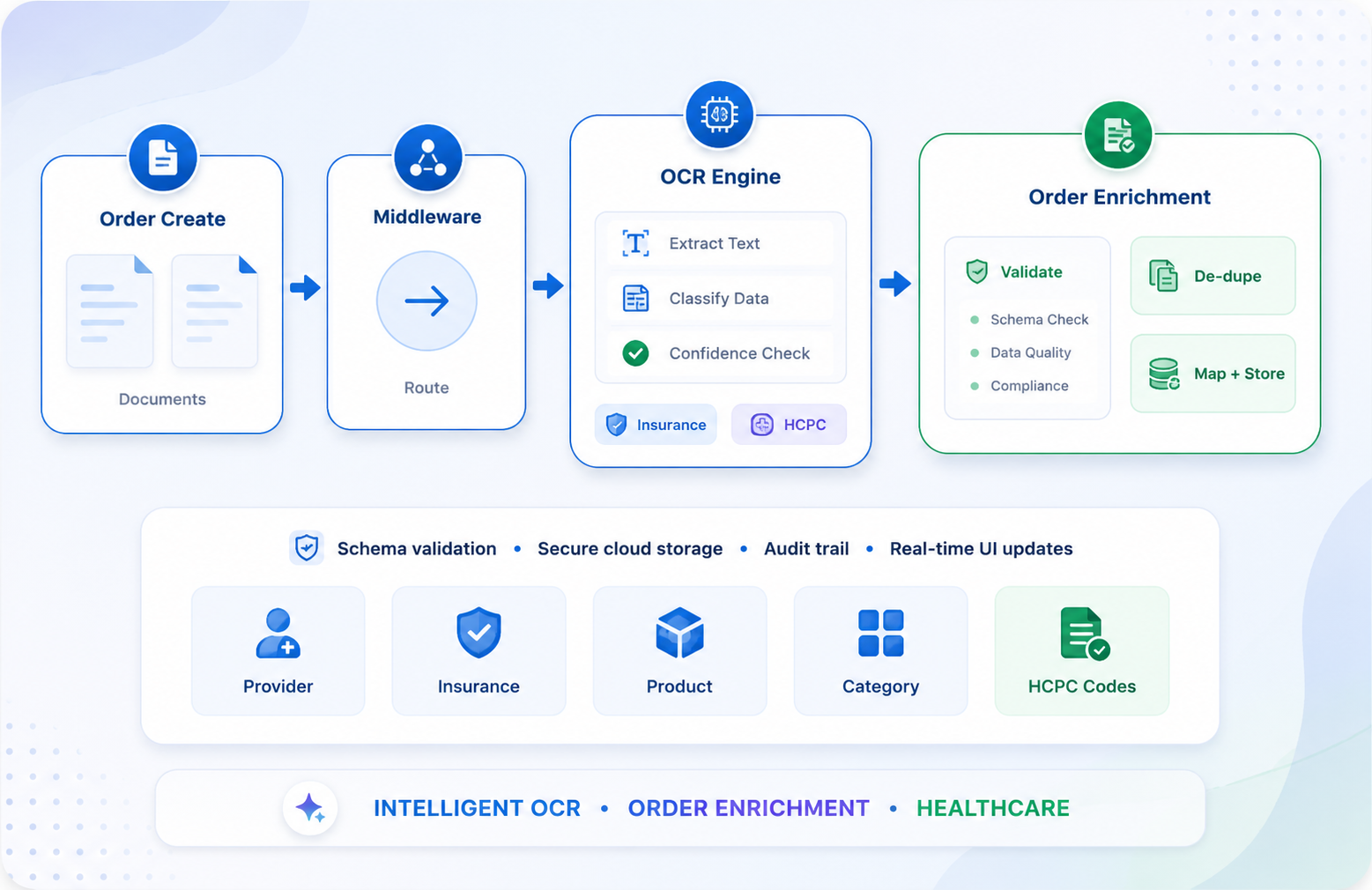
We designed an automated workflow connecting order creation, integration middleware, OCR processing, and order management systems to streamline healthcare order processing. Documents submitted during order creation are routed asynchronously for OCR processing and intelligent extraction. The integration layer validates incoming payloads against strict schemas, detects duplicate document submissions, securely stores extracted results, maps business data into operational entities, persists metadata for audit trails, and enriches order records for immediate visibility in the operational UI.
Delivery
The solution
The Intelligent Document OCR Integration Platform begins when an order is created with supporting documents in the order creation system. Documents are automatically transmitted through the integration middleware and submitted to the OCR service for intelligent document extraction. Once extraction completes, structured JSON is returned containing insurance details, provider information, product references, categories, and HCPC codes. The order management platform receives the extracted payload through a dedicated OCR integration endpoint where schema validation, duplicate document detection, secure storage of extracted OCR results, business data mapping and normalization, metadata persistence, audit trail generation, and user interface updates are performed. Extracted information is automatically associated with the corresponding order and displayed within the order management portal, allowing operational teams to review and manage enriched order data without manual re-entry.
Results
Key metrics
- Automated extraction
- Data Entry
- Schema-enforced
- Validation
- Detection framework
- Duplicates
- Full lifecycle audit
- Traceability
Impact
Results & outcomes
- Faster order processing with automated OCR extraction reducing manual document review and data entry
- Improved data accuracy through structured validation and automated mapping
- Reduced operational costs by eliminating repetitive administrative tasks
- Enhanced data integrity with duplicate detection preventing redundant document processing
- Better compliance and auditability via comprehensive metadata storage and audit logging
- Improved user experience with enriched order details immediately available in the order management UI
- Scalable asynchronous processing supporting growing document volumes without impacting order creation
- End-to-end traceability from document submission through extraction, validation, storage, and consumption
Tech used
Technology stack
Tools and patterns from this engagement—your stack may differ.