


Summary
Overview
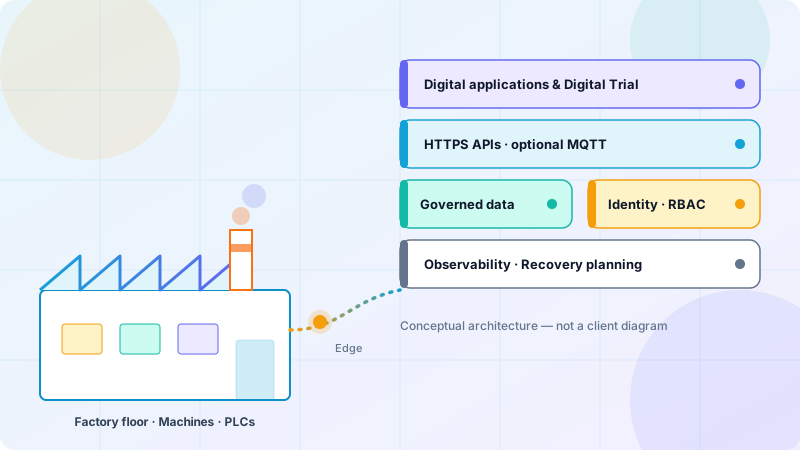
A European manufacturing enterprise operating production facilities in Vietnam needed a structured digital architecture to connect established manufacturing infrastructure with modern enterprise systems. KyszTech contributed architecture and digitalization planning expertise, outlining a modular approach to operational integration, workflow modernization, data governance, and future scalability. This was an architecture consulting and solution design engagement, not a completed production deployment.
Context
The challenge
The goal was to modernize without unnecessary disruption of working production systems. Five areas shaped the architecture:
- 01
Fragmented systems and data flows
Manufacturing systems and operational data flows were fragmented, making a consistent view of operations hard to establish.
- 02
Manual, disconnected workflows
Manual processes and disconnected workflows limited traceability and made approvals and records difficult to manage consistently.
- 03
Existing machinery and edge systems
Integration had to work with existing machinery, PLCs, and edge systems that were already proven on the factory floor.
- 04
Security, identity, and governance
Enterprise security, identity, intellectual property protection, and data governance needed clear principles from the start.
- 05
Scalability for future innovation
The architecture needed room for future workflows, analytics, and innovation without rework of the foundation.
How we worked
Our approach
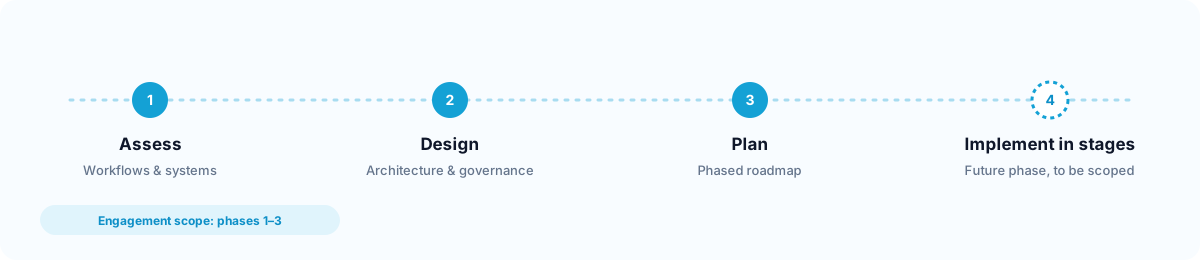
1.Manufacturing context and workflow assessment
Understanding how production, trials, and operational workflows run today, and where systems and handoffs are disconnected.
2.High-level digital architecture design
Defining layers, boundaries, and responsibilities so new capabilities attach to the existing environment cleanly.
3.HTTPS-first API integration
Standardizing on HTTPS APIs for integration, with MQTT as an optional mechanism where event-style messaging is appropriate.
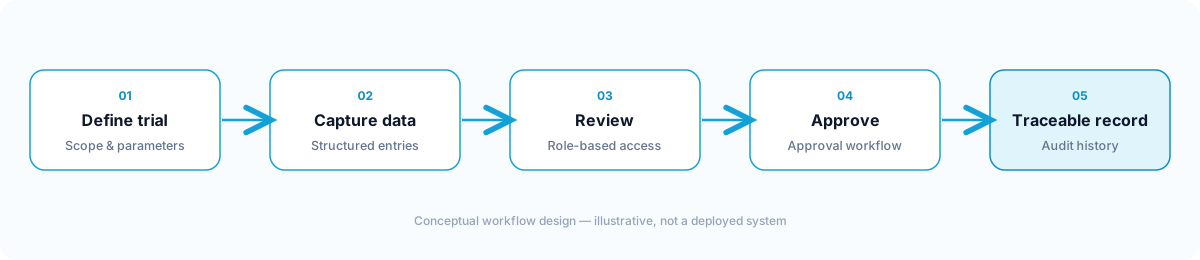
4.Digital Trial management concepts
Shaping structured Digital Trial records, approval workflows, and traceable histories.
5.Governance principles
Establishing principles for security, identity, data ownership, and access across applications and data.
6.Phased modernization planning
Sequencing modernization and implementation planning so value can be introduced in stages with limited operational risk.
Design direction
Proposed solution
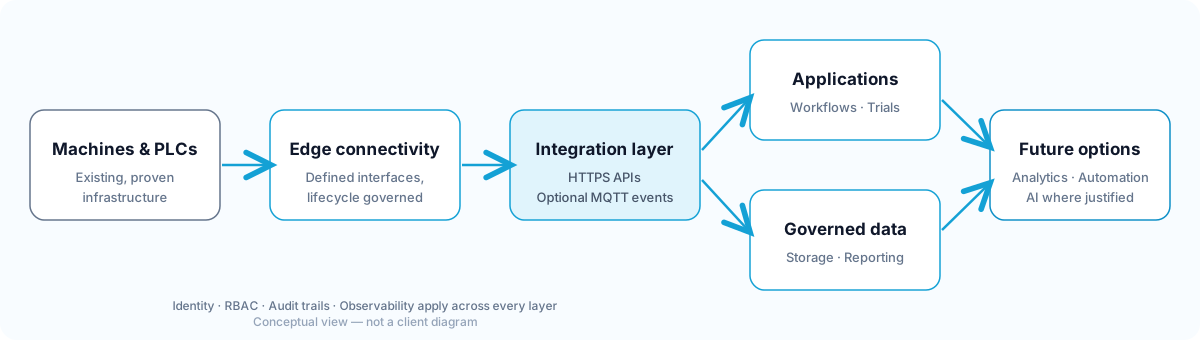
The proposed solution is organized around six architectural areas. It is a design direction, not a description of a deployed system.
Manufacturing connectivity
Preserve proven machine, PLC, and edge infrastructure, and connect to it through defined interfaces rather than replacing it.
Enterprise integration
Standardize HTTPS-based APIs across systems, with optional event messaging where it fits the use case.
Digital applications
Modular workflow applications with structured Digital Trial records that support approvals and traceability.
Governed data
Managed operational storage, curated data, and reporting readiness, with clear ownership.
Security and operations
Corporate identity, role-based access control, auditability, observability, recovery planning, and edge lifecycle governance.
Future innovation
Extensibility for analytics, automation, and AI where justified by a clear business case.
The architecture also outlines digitalization concepts for inventory and utility tracking, using the same integration and governance foundations.
Focus areas
Key engagement highlights
Architecture-led modernization
Design decisions and boundaries defined before implementation begins.
API-first integration
Consistent, HTTPS-based interfaces between factory and enterprise systems.
Existing industrial infrastructure preserved
Proven machines, PLCs, and edge systems remain in place.
Digital Trial workflow design
Structured records, approvals, and traceability concepts.
Secure data governance
Identity, ownership, access, and audit principles applied to operational data.
Phased digitalization roadmap
A staged path from current state toward future capabilities.
These are architectural focus areas of the engagement, not numerical results.
Deliverables
Outcomes
- A documented high-level modernization direction
- Defined integration approach and architectural boundaries
- Structured concepts for Digital Trial workflows and traceability
- Data governance and enterprise security principles
- Planning foundation for later implementation phases
- Extensible architecture for future manufacturing capabilities
The engagement produced architecture and planning outcomes. It did not include a production rollout, and no measured operational improvements are claimed.
Technology
Technology & architecture
The layers below are architecture concepts and proposed technology directions. Final technology choices would be confirmed during implementation planning.
- Industrial
- Machine InterfacesPLCEdge Connectivity
- Integration
- REST APIsHTTPSOptional MQTT
- Application
- ReactTypeScriptModular Web Applications
- Governance
- RBACIdentityAudit TrailsGoverned Storage
- Operations
- ObservabilityRecovery Planning
Potential benefits
Business value
These are potential benefits the architecture is designed to enable. They are design intentions and have not been measured in production.
Reduced integration complexity
Standardized interfaces and clear boundaries reduce one-off connections between systems.
Preservation of manufacturing investments
Existing machinery, PLCs, and edge systems are connected, not replaced.
Consistent operational data
Governed storage and curated data support a shared view across teams.
Stronger governance
Identity, access control, and audit trails support security and IP protection.
Modular extensibility
New workflows, analytics, and automation can be added without redesigning the foundation.
A clearer modernization roadmap
Phased planning gives decision-makers a practical sequence for investment.
Client details are confidential. No client names, internal documents, or architecture diagrams are published.