


Context
The challenge
Traditional DME and hospital order-entry workflows often rely on manual insurance verification through payer portals or disconnected eligibility systems. Staff members must leave the order-entry workflow, re-enter patient and insurance details across multiple external systems, and wait for responses before completing order processing—creating delays, increasing operational overhead, and introducing data-entry errors. Manual verification workflows typically provide limited visibility into request history, verification status, and response traceability. Without a centralized integration layer, healthcare organizations struggle to audit verification attempts, track billable transactions, and scale eligibility verification across multiple payers or tenants. Healthcare providers require a unified and scalable eligibility verification solution that performs real-time insurance checks during order entry, reduces manual effort, preserves user productivity, and maintains a complete audit trail for every verification transaction.
How we worked
Our approach
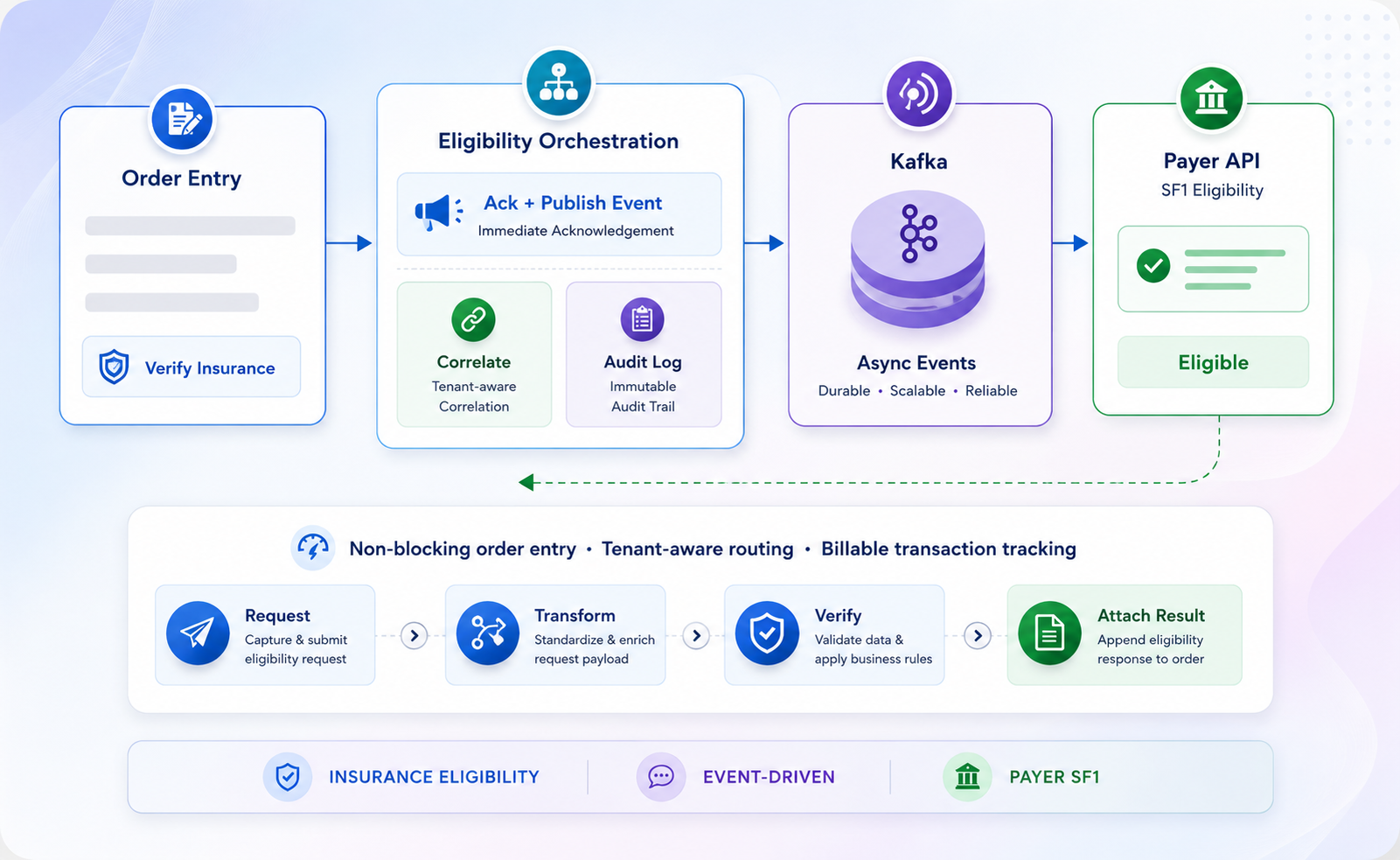
We implemented an event-driven insurance eligibility verification platform with external payer integration, introducing an asynchronous eligibility workflow that allows order-entry staff to continue their work while insurance verification processes in the background. Payer-specific transformation logic is kept outside the core order workflow through external integration components, enabling a loosely coupled, scalable, and vendor-extensible architecture with tenant-aware topic naming, callback routing, and event isolation for multi-tenant traffic separation.
Delivery
The solution
The workflow begins when the Order Management Platform initiates an insurance eligibility verification request during order entry. The request is sent to the Eligibility Orchestration Service, which immediately acknowledges the request and publishes an insurance verification event to Kafka. Downstream Integration Components consume the event, transform the request payload into payer-specific SF1 format, and invoke the external eligibility service. Once the payer returns the eligibility response, the response is published back through Kafka and consumed by the orchestration layer. The structured result is correlated to the originating order using external identifiers and attached to the order record for downstream viewing, processing, and audit tracking. The system persists request/response metadata, status transitions, and billable transaction details to ensure complete operational traceability.
Results
Key metrics
- Event-driven async
- Workflow
- Payer SF1
- Integration
- Kafka pipeline
- Messaging
- Full lifecycle
- Audit Trail
Impact
Results & outcomes
- Real-time eligibility verification triggered directly from order entry without payer portal lookups
- Non-blocking order-entry experience with immediate API acknowledgment while verification runs in background
- Reduced manual effort by eliminating repeated patient and insurance data entry across external systems
- Complete audit and compliance visibility for every eligibility request, response, callback, and status update
- Scalable payer integration model with SF1 transformation externalized from the core order platform
- Tenant-aware processing with topic naming and callback routing for secure multi-tenant traffic isolation
- Payer-agnostic extensibility supporting additional insurance verification vendors with minimal workflow changes
- Faster verification turnaround with eligibility results attached asynchronously to originating orders
Tech used
Technology stack
Tools and patterns from this engagement—your stack may differ.