


Context
The challenge
Large-scale enterprise frontend applications often evolve into fragmented systems with inconsistent API handling, duplicated state logic, scattered error management, outdated dependencies, and non-standardized UI patterns. As products scale, maintaining consistency across authentication, permissions, caching, notifications, tables, forms, and loading states becomes increasingly difficult—reducing developer productivity, destabilizing user experiences, and increasing maintenance overhead. Existing architectures frequently suffer from schema drift between frontend and backend, inefficient API communication, poor scalability of role-based permissions, and a lack of reusable infrastructure for enterprise-grade features.
How we worked
Our approach
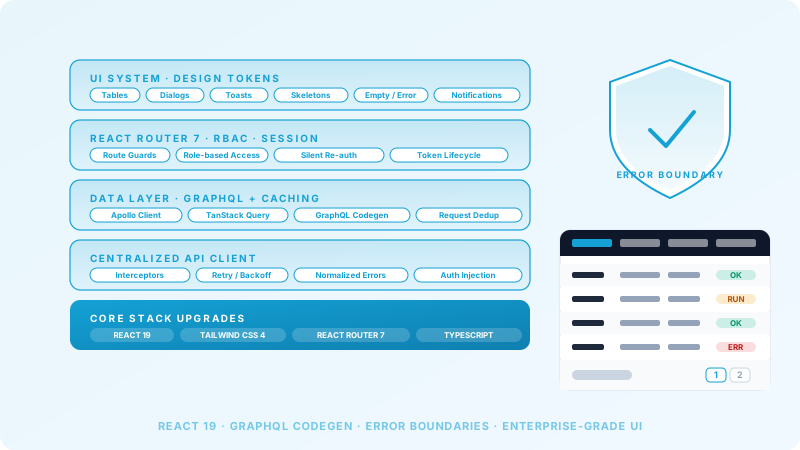
We led a Frontend Architecture & Platform Modernization initiative introducing a scalable, standardized frontend foundation: React 19, Tailwind CSS 4, React Router 7, a centralized API layer, GraphQL query optimization, reusable enterprise UI primitives, and enterprise-grade authentication workflows. Migrations were executed without disrupting business workflows, with compatibility-focused refactors module by module.
Delivery
The solution
Centralized API clients with request/response interceptors, token injection, retry handling, and normalized error processing replaced scattered networking code. Apollo Client / TanStack Query power GraphQL caching, request deduplication, and optimized loading states, while GraphQL Code Generator emits typed hooks and operations directly from the schema—eliminating schema drift and manual TS maintenance. A global Error Boundary system delivers graceful fallback UI and centralized exception management. Reusable enterprise UI primitives (tables, loaders, skeletons, dialogs, toasts, empty/error states) sit on top of standardized design tokens for colors, spacing, and surfaces. TanStack Table / AG Grid power enterprise data grids with filtering, sorting, virtualization, and export. A scalable RBAC architecture provides route-level and module-level authorization, while token lifecycle management, silent re-authentication, and session expiry workflows secure long-running user sessions.
Results
Key metrics
- React 19, Tailwind 4, RR 7
- Core Upgrade
- Apollo / TanStack Query + Codegen
- Data Layer
- TanStack Table / AG Grid (virtualized)
- Tables
- Global Error Boundaries + RBAC
- Resilience
Impact
Results & outcomes
- Modernized stack on React 19, Tailwind 4, React Router 7 — future-ready and ecosystem-aligned
- Centralized API + GraphQL caching eliminates duplicated networking logic and improves load behavior
- Typed GraphQL operations remove schema drift and dramatically reduce manual TypeScript maintenance
- Global Error Boundaries cut runtime crashes and deliver graceful fallback experiences
- Reusable enterprise UI system standardizes tables, loaders, dialogs, toasts, and empty/error states across modules
- Scalable RBAC with route- and module-level authorization plus secure session lifecycle management
Tech used
Technology stack
Tools and patterns from this engagement—your stack may differ.